The Indole Paradox of L'Interdit
- perfumery
- design
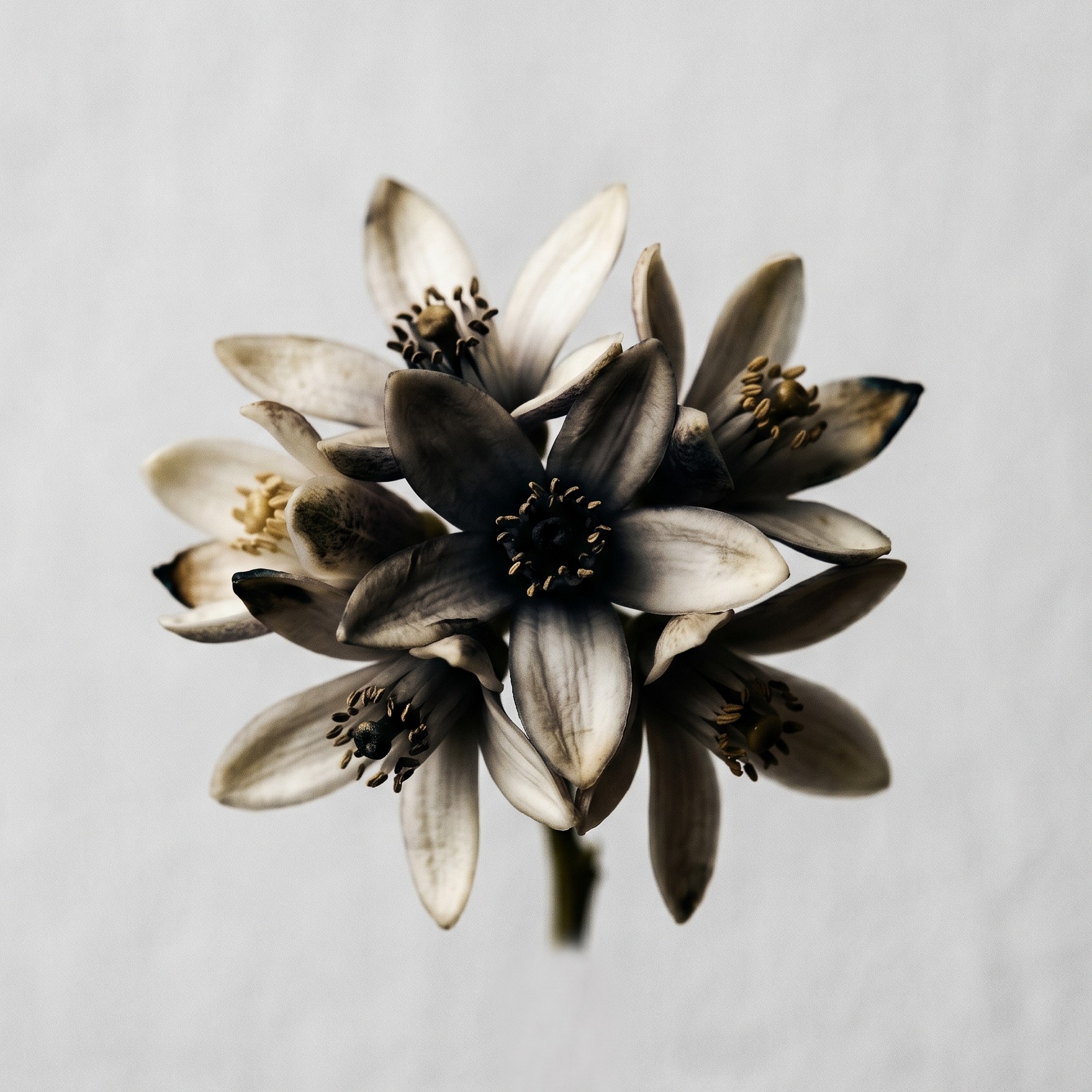
L'Interdit by Givenchy, from the legendary Dominique Ropion, is one of the perfumes with the highest concentration of orange blossom materials, along with And The World Is Yours by What We Do Is Secret, also from Ropion. And yet, paradoxically, the perfume is generally referred to as dark, not bright.
The official description of L'Interdit positions it around a central tension: white flowers against a dark base. Light against shadow. Orange blossom, jasmine, and tuberose on one side; patchouli and vetiver on the other. The marketing language suggests a contrast, a collision, the forbidden thrill of two opposing things held together in the same bottle.
This framing is wrong. Or at least, it's describing the right result for the wrong reason.
The darkness in L'Interdit doesn't come from patchouli fighting against neroli. It comes from the neroli itself.
The 4G orange blossom accord
Givenchy uses what they call the "4G" orange blossom accord across the L'Interdit line: four separate extractions of the same flower, from the same Tunisian source. Neroli essential oil (steam distillation of the blossoms). Orange blossom absolute (solvent extraction). Orange blossom concrete. Orange blossom CO2 extract. Each extraction method captures different chemical fractions of the plant — different molecular weight compounds, different volatility profiles, different facets of the same flower. The neroli is brighter and more citrusy; the absolute is heavier, richer, more narcotic. Together they constitute something closer to the complete chemical identity of the orange blossom than any single extraction could provide.
At high concentration, that complete identity is not what most people think orange blossom smells like.
When indole crosses a threshold
The molecule responsible is indole. It's present in trace quantities in every white floral absolute — neroli, orange blossom, jasmine, tuberose, gardenia, narcissus. At those trace quantities, it does something essential: it gives white florals their natural quality, their warmth, their slightly animalic aliveness. Without indole, white florals smell synthetic. Too clean. Correct but lifeless, the difference between a photograph of a flower and the actual flower in a room.
But indole is not a well-behaved molecule. Its behavior changes non-linearly with concentration. At trace dilution — below a fraction of a percent — it's narcotic and waxy, dense and creamy, the quality that makes white florals addictive rather than merely pretty. Push past a certain threshold and the character inverts completely. It doesn't just become stronger. It becomes something else. Animalic, dark, biological. One source describes the transition as a cliff rather than a slope — not gradual, but a phase shift. The molecule is the same. The dose is different. The result is categorically different.
This is not peculiar to perfumery. Phase transitions are common in physical systems: the same water molecules at 99°C and at 101°C are qualitatively different states. The quantity changes continuously; the properties flip discretely at the boundary. Indole behaves the same way. There is a dosage threshold below which it generates florality and above which it generates something closer to its animal origins. Perfumery textbooks note, without much irony, that indole is the same compound found in human waste — what changes everything is that flowers produce it in quantities just below the inversion threshold, which is why they smell like flowers and not like the alternative.
What Ropion is doing with L'Interdit is using four extractions of orange blossom at high total concentration. This almost certainly pushes the indolic load of the formula past or toward the inversion threshold. The fragrance smells dark not because dark ingredients have been added to a bright floral. It smells dark because the floral, at that dosage, generates its own darkness. The orange blossom is eating itself.
The base aligned, not opposed
This reframes what Ropion actually built. The patchouli and vetiver in the base are not the antagonist to the white floral protagonist. They're not providing darkness that the flowers lack. They're providing harmonic resolution for where the flowers are already going. Ropion doesn't compose bright floral plus dark base. He composes one dark thing with two sources — the darkness the base materials naturally carry, and the darkness the flower generates at high concentration — and he aligns them so they arrive at the same destination from different directions.
That alignment is why the fragrance feels integrated rather than split. Most floral-oriental compositions are legibly bifurcated: you smell the flowers, you smell the base, you feel the construction. L'Interdit doesn't present that bifurcation because it isn't structured that way. The base isn't opposing the flowers. The base is completing the arc the flowers have already started.
What a dark floral actually is
This is the deeper logic of what we usually call "dark florals" as a category — and why most perfumes that attempt the category fail at it. The failure mode is additive: you take a perfectly pleasant white floral and add some dark materials underneath it. You get a fragrance with two separate personalities occupying the same bottle. On paper it reads as "dark floral." On skin it reads as a floral fragrance and separately a dark fragrance, arranged vertically, one on top of the other.
A real dark floral isn't a construction of two things. It's a single thing that produces its own contradiction — a flower that is genuinely dark at its source, not made dark by its context. Tuberose does this naturally, which is why it's the most common engine of the genre; its indolic load is high enough that at almost any serious concentration it starts to go somewhere ambiguous, narcotic, alive-in-an-uncomfortable-way. Orange blossom does it too, but it requires dosage to get there. At the concentrations most perfumes use, orange blossom stays in its clean, citrusy mode. The darkness requires commitment.
The four-extraction approach in L'Interdit is an instrument for reaching that commitment. You're not using more of one thing; you're using more of all the facets of the thing simultaneously. The cumulative indolic load becomes enough to push the flower past its clean threshold into its narcotic one. What you smell isn't orange blossom the way it smells in a light citrus cologne. You smell orange blossom the way it would smell if you were very close to a large quantity of it in a dark room.
The paradox stated plainly: the ingredient responsible for the darkness in L'Interdit is orange blossom. Not despite its concentration but because of it. The most present ingredient produces the defining character, and that character is the opposite of what the ingredient usually produces. The dark floral isn't a floral made dark. It's a floral that inverts itself.
Ropion understood this and built around it. Most perfumers treat white florals as the bright element to be anchored. He treats the white floral as the anchor — a dark one, if you push it far enough — and lets everything else respond.